

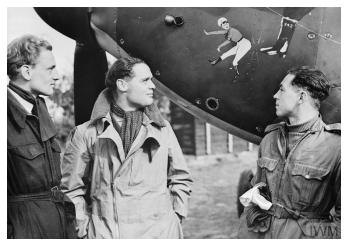
When France surrendered and Britain, after Dunkirk, was clearly prepared to carry on fighting Nazi Germany, Hitler began to prepare for an invasion of England – Operation SEALION. The Germans decided first to destroy Britain’s air defences. Churchill addressed the House of Commons saying:
What General Weygand called the Battle of France is over. I expect that the Battle of Britain is about to begin. Upon this battle depends the survival of Christian civilisations. Upon it depends our own British life, and the long continuity of our institutions and our Empire. The whole fury and might of the enemy must very soon be turned on us. Hitler knows that he will have to break us in this Island or lose the war. If we can stand up to him, all Europe may be free, and the life of the world may move forward into broad, sunlit uplands. But if we fail, then the whole world, including the United States, including all that we have known and cared for, will sink into the abyss of a new Dark Age made more sinister, and perhaps more protracted, by the lights of perverted science. Let us therefore brace ourselves to our duties, and so bear ourselves that if the British Empire and its Commonwealth last for a thousand years, men will still say, ‘This was their finest hour’
Following German recce, ‘nuisance’ raids and mine laying, the first engagements for the Royal Air Force (RAF) took place over the English Channel from 9 July 1940. The main Luftwaffe offensive code-named Alderangriff (Eagle attack), was launched against the RAF on 13 August 1940. The most intense fighting was in the skies above southeast England, where the Luftwaffe attempted to destroy Britain’s air defences and 18 August was nicknamed ‘The Hardest Day’, the day when both air forces inflicted the greatest number of casualties in the conflict. The Germans targeted first of all the radar infrastructure and then the airfields but was unable to achieve victory.
The RAF were not all from the UK, with pilots and crews from countries including, Australia, Canada, Czechoslovakia, Ireland, New Zealand, Poland, South Africa and the USA. When the RAF carried out a night-bombing raid over Berlin on 25 August 1940, Hitler, promising to wipe out Britain’s cities, retaliated within days in a massive one-thousand bomber raid on London’s docks. This switch also indicated that the German attempt to inflict a strategic blow to Britain’s defences had failed.
Winston Churchill afterwards said:
… The gratitude of every home in our Island, in our Empire, and indeed throughout the world, except in the abodes of the guilty, goes out to the British airmen who, undaunted by odds, unwearied in their constant challenge and mortal danger, are turning the tide of the World War by their prowess and by their devotion. Never in the field of human conflict was so much owed by so many to so few
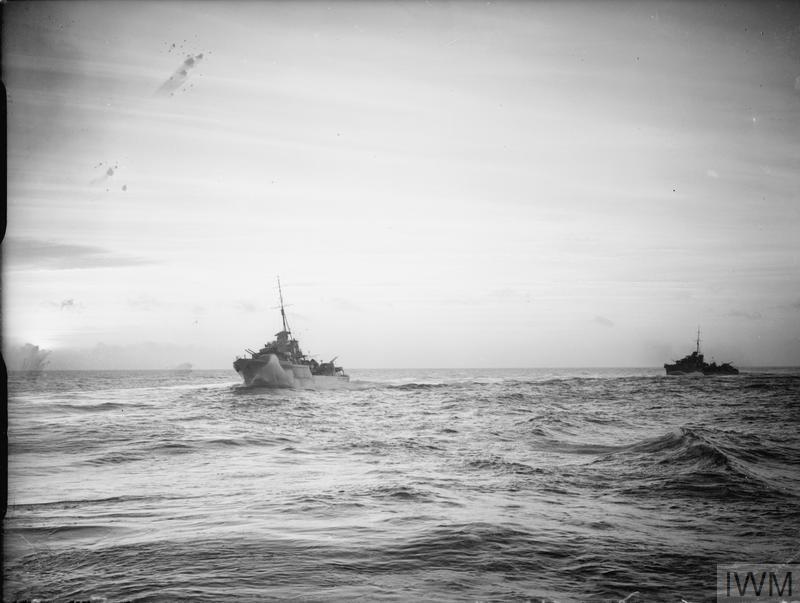 (Left, J and K Class destroyers on patrol in the English Channel (© IWM (A 2034))
However, there is little doubt that the largest operational naval fleet in the world stood ready to destroy any such invasion – the Royal Navy. On 17 September, Hitler ordered the invasion to be postponed and therefore avoided the probable outcome of proceeding with Op SEALION – defeat. The German Naval Historical Staff in a 1944 document wrote:
… just as in Napoleon’s invasion plans in 1805, the fundamental requirement for success was lacking, that is, command of the sea. This lack of superiority at sea was to be compensated for by air superiority. But it was never even possible to destroy enemy sea superiority by use of our own air superiority… The sea area in which we were to operate was dominated by a well-prepared opponent who was determined to fight to the utmost of his ability. …
The true victory for Churchill was that the Battle of Britain, and other events such as Dunkirk and the Blitz, helped to gain the US Congress’ sympathies and economic support for what would become the US Lend-Lease Act in 1941.