

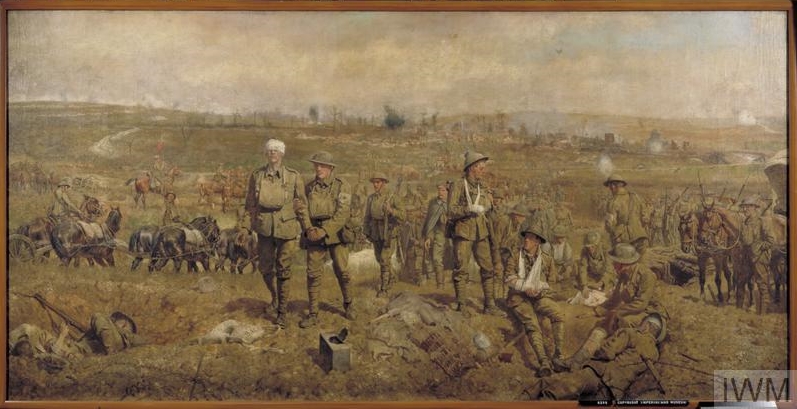
(Above, The Breaking of the Hindenburg Line by J P B Beadle, 1918 (© IWM Art.IWM ART 6296))
Marshal Foch launched his Grand Offensive with French and US offensives in the Meuse-Argonne on 26 September 1918 . The Army Group in Flanders, with King Albert I of Belgium as Commander-in-Chief, consisting of the Belgian Army, the British Second Army, and the French Sixth Army, launched the Fifth Battle of Ypres on 28 September.
At 0500 hours on 29 September 1918, General Sir Henry Rawlinson’s Fourth (UK) Army attacked the heart of the Hindenburg Line on a front of twelve miles with the IX British Corps and the II US Corps, with the Australian Corps in support behind it. General Marie-Eugène Debeney’s First (French) Army extended the battle front to the south, while two corps of the Third (UK) Army extended it to the north as far as Marcoing on the St Quentin Canal.
By 5 October, the Allies had broken through the Hindenburg line’s defences over a 31 km front and, by 8 October, the First and Third (UK) Army had broken through the Hindenburg Line following the Second Battle of Cambrai. It was these events that began to force the Germans into accepting that an armistice would need to be sought to end the fighting – and the war.